The Gift That Outlasts the Ribbon-Cutting: Reframing Collections Care as a Donor's Legacy
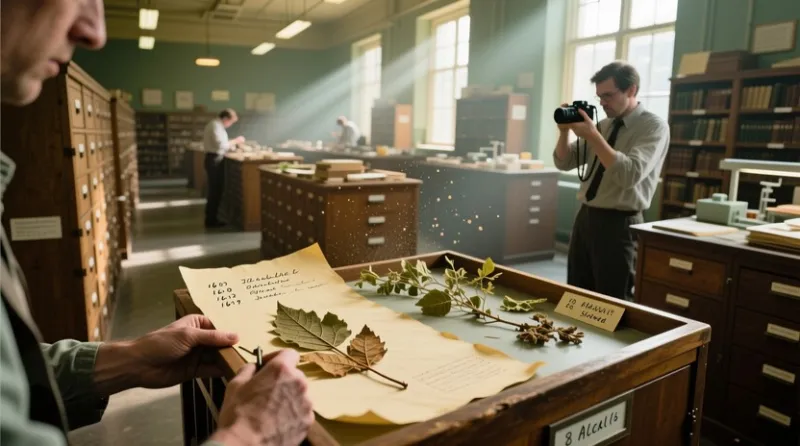
Photo: scientist examining herbarium specimen drawers in museum archive storage, via images.stockcake.com
Every fundraising season, the same pattern repeats itself across American science philanthropy. A family foundation announces a gleaming research pavilion. A university breaks ground on an innovation hub, complete with renderings of glass atriums and smiling undergraduates. Meanwhile, a few floors below or a few miles away, herbarium sheets yellow under failing HVAC systems, frozen seed collections hover dangerously close to their temperature tolerances, and a museum's oral history archive sits on a single unbacked-up hard drive.
The imbalance is not a failure of donor generosity. It is a failure of framing. And for development officers at small research nonprofits, learning to correct that framing may be the single highest-leverage skill they can develop.
Why the Building Wins
The psychology is not mysterious. A building is legible. It has an address, a photograph, a dedication ceremony. A donor can stand in front of it and point. Collections care, by contrast, is what fundraisers sometimes call the "invisible middle" — the ongoing, unglamorous labor of monitoring humidity, rotating desiccants, updating accession records, and training the next generation of collections managers. It produces no ribbon to cut and no plaque to touch.
There is also a structural bias at work. Capital campaigns come with professional marketing, naming opportunities, and clear price tags. Stewardship funding arrives, when it arrives at all, as an afterthought — a line item squeezed into an operating budget or covered temporarily by a grant that everyone knows will expire. Many small nonprofits have internalized this hierarchy so deeply that they hesitate to even ask for unrestricted care funding, assuming donors will find it unworthy.
The evidence suggests otherwise. Donors are not allergic to stewardship; they have simply rarely been offered it in a language that speaks to what they actually want.
What Legacy Donors Are Really Buying
Interviews with planned-giving professionals across the nonprofit sector reveal a consistent truth: donors at the major-gift level are rarely purchasing an outcome. They are purchasing continuity — the assurance that something they value will persist beyond their own lifetimes.
Consider what collections care actually offers in that light. A named laboratory will need renovation within a generation. A program may be restructured or eliminated by a future administration. But a properly endowed herbarium, a funded seed vault, or a permanently supported archive is, quite literally, designed to outlast the donor. It is the rare gift whose useful life is measured in centuries.
Several fundraisers have built successful campaigns on exactly this insight. Their approach is consistent: they stop describing collections care as maintenance and start describing it as permanence. They walk donors through the vaults and show them the 1890s plant specimens now being used to track climate shifts. They introduce the collections manager — often an underpaid, deeply knowledgeable professional — and let the donor meet the person their gift will sustain. They present the alternative honestly: without stable funding, this material does not merely languish; it disappears.
One development officer at a small natural history nonprofit describes her pitch in a single sentence: "I'm not asking you to keep the lights on. I'm asking you to make sure the lights are still on in two hundred years."
A Playbook for Small Nonprofits
For development teams without large capital campaign machinery, the path to collections funding follows a few repeatable principles.
Name the consequence of inaction. Donors respond to loss aversion more reliably than to abstract value. Quantify what a gap in care funding would actually cost — in degraded specimens, lost data, lapsed accreditations. The phrase "deferred maintenance" is accurate but inert; "irreversible loss" is accurate and motivating.
Convert operating costs into endowed units. A request for "$40,000 annually for collections care" invites comparison to program budgets. The same request, reframed as "the endowment that keeps the region's only frozen seed archive viable forever," invites comparison to legacy giving. Offer tiers: a named drawer, a named cabinet, a named vault. The underlying asset is the same; the emotional architecture is different.
Pair the collection with its public purpose. Stewardship alone can feel inward-facing. Connect the archive to its downstream users — the teachers who borrow specimens, the researchers tracking drought, the tribal partners recovering traditional ecological knowledge. A collection framed as community infrastructure is far easier to fund than one framed as back-office expense.
Recruit the collections staff as ambassadors. The most persuasive voice in a collections campaign is rarely the development office. It is the curator who can explain, with genuine feeling, why a single drawer of 1930s grass specimens from the Great Plains is now indispensable to rangeland science. Invest in making these experts comfortable with donors.
Ask for permanence explicitly. Many donors default to buildings and programs because no one has ever invited them to fund forever. Be the organization that makes the invitation.
The Stewardship Argument
At its core, this is not merely a fundraising tactic — it is a claim about what stewardship means. An organization that builds but does not preserve has made a promise it cannot keep. The specimens, records, and living collections held by America's research nonprofits constitute a public trust, and trusts require custodians with stable resources.
Donors who understand this are not settling for something less glamorous than a building. They are choosing the only gift in the portfolio that genuinely cannot become obsolete. The task before development officers is to say so — clearly, confidently, and before the freezer fails.