Second Shift for Science: The Night Workers Who Keep America's Collections Alive
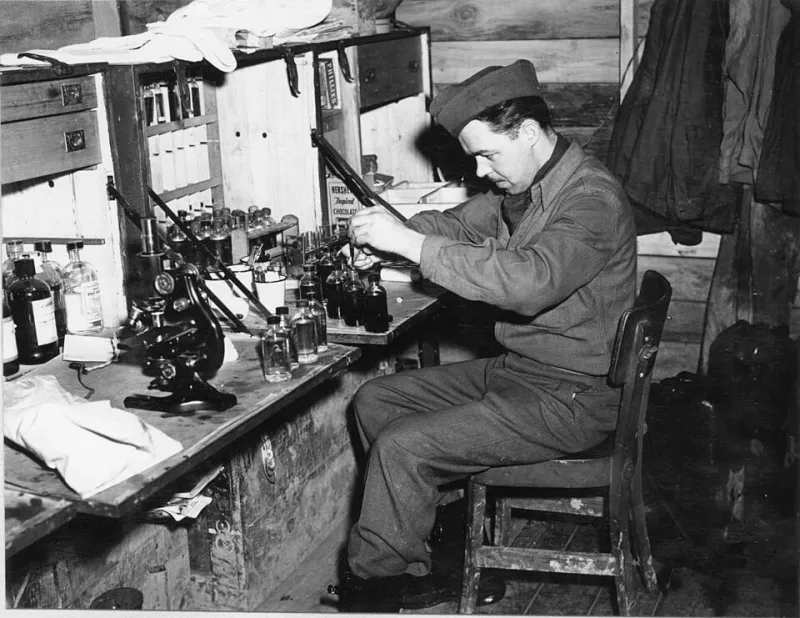
Photo: National Museum of Health and Medicine, CC BY 2.0, via Wikimedia Commons
At 11:40 p.m. on a Tuesday, the front doors of a natural history museum in the Midwest have been locked for hours. Yet two floors below the public halls, the lights in the herbarium are on. A technician in a lab coat moves between cabinets with a handheld scanner, logging the temperature and humidity of each compactor range. Down the corridor, a small data-entry team works through a backlog of digitized plant specimens, transcribing handwritten labels from the 1890s into a database that researchers on three continents will consult by morning.
None of this work will appear in an exhibition. None of it will trend. And yet, without it, the collections that anchor American biodiversity science would slowly, silently deteriorate.
The Collection Never Sleeps
Natural science collections are often described as libraries of life, but the metaphor understates the maintenance. A book can wait decades on a shelf; a pressed plant, a pinned beetle, or a pickled fish cannot. Specimens respond to fluctuations in humidity, to pest outbreaks, to the slow chemistry of their own preservation. Integrated pest management requires monitoring traps to be checked on a schedule. Fluid-preserved collections need fluid levels topped off and concentrations verified. Freeze-treatment protocols for insect-infested materials run in cycles measured in days — cycles that do not pause for weekends or holidays.
This is why the night shift exists. At a university museum in New England, the conservator responsible for the fluid collections describes her overnight schedule as a matter of physics rather than preference: bulk freezing of infested specimens ties up the fumigation chambers for seventy-two hours at a stretch, and someone must move materials in and out on that clock. At a Gulf Coast collection, the overnight crew doubles as the disaster-response core. When a pipe burst above the ornithology range several years ago, it was the two technicians closing out the digitization shift who spotted the drip within minutes — and the wet specimens were on drying racks before sunrise.
Three Institutions, One Pattern
RSSE spoke with staff at three very different institutions: a large university herbarium in the Midwest, a state natural history survey on the Gulf Coast, and a mid-sized independent museum in the Northeast. The settings differ, but the pattern is strikingly consistent.
The university herbarium relies on graduate students and part-time technicians for its after-hours digitization. The state survey, better funded, employs a permanent collections-care staff — but even there, the night crew is a fraction of the size of the curatorial team, and the backlog of unprocessed accessions stretches back years. The independent museum, operating without an endowment, covers its overnight monitoring through a rotation of volunteers and a single full-time registrar who, by her own account, works "the hours the building needs, not the hours the budget acknowledges."
In all three cases, the people doing this labor describe it with genuine affection. They also describe a persistent anxiety: that the work is invisible precisely because it succeeds. A collection that never suffers a pest outbreak or a humidity disaster can look, from the outside, like a collection that needs no care.
The Funding Gap Behind the Cabinet Doors
Here lies the problem that deserves the attention of every foundation and agency supporting informal science education and research infrastructure. American philanthropy is drawn to the visible: new wings, digitization sprints, public programs, discovery announcements. What it struggles to fund is the steady, unglamorous labor that makes any of those investments durable.
The results are measurable. Surveys of the natural science collections community have repeatedly documented deferred maintenance, unfilled technician positions, and digitization backlogs measured in decades. A grant that pays for scanning two hundred thousand specimens accomplishes little if no one is funded to maintain the imaging equipment, monitor the storage environment, or keep the resulting database current. The scan is an event; stewardship is a habit. Our funding culture rewards events.
This is not an argument against ambitious projects. It is an argument for a line item that almost never appears: sustained support for the human beings who keep collections viable between the milestones. Collections care technicians, conservators, and data managers are, functionally, the trust infrastructure of American science. Every climate study that uses herbarium specimens to reconstruct historical flowering dates, every taxonomic revision that resolves a species boundary, every K-12 outreach program built on a museum loan kit — all of it rests on people whose work most donors will never see.
What Responsible Stewardship Would Look Like
The remedies are neither mysterious nor expensive relative to the value they protect.
First, funders of collections-based science should normalize multi-year support for care staff, not just project staff. A five-year digitization grant that includes a permanent, benefits-eligible technician line is worth more than a ten-year grant that does not.
Second, institutions should count and report care labor honestly — hours of environmental monitoring, pest management, and database maintenance — so that the true cost of a collection becomes legible to trustees and donors alike.
Third, philanthropists should recognize that stewardship of collections is a form of community stewardship. These specimens belong to the public in a meaningful sense; they document a continent's living heritage across more than a century of change. The people who protect them at midnight are performing a public service, whether or not anyone is watching.
Somewhere tonight, in a basement range in Ohio or a coastal vault in Alabama, a technician is checking a hygrometer and noting that Cabinet 114 is holding steady at 45 percent relative humidity. Nothing dramatic will come of it. Nothing dramatic is supposed to. That, in the end, is the point: the most important work in American science is often the work that quietly prevents catastrophe, one uneventful evening at a time. It deserves to be funded as though we understood that.