Cold Storage, Warm Stakes: The Quiet Financial Crisis Inside America's Biobanks
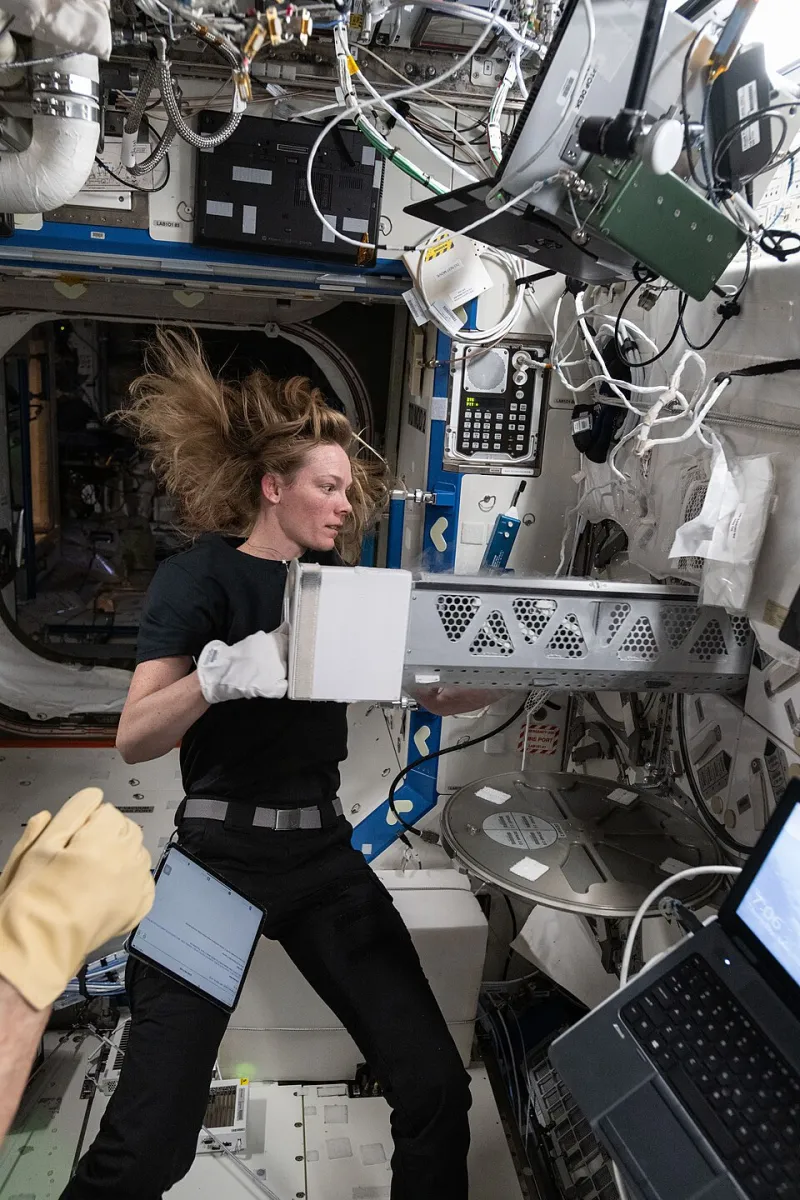
Photo: NASA Johnson Space Center, Public domain, via Wikimedia Commons
In an unremarkable utility corridor beneath a university medical center in the Midwest, a bank of ultracold freezers holds material that cannot be replaced at any price: cell lines gathered over five decades, tissue samples tied to studies that shaped modern oncology, and genetic material from rare plant species now extinct in the wild. The compressors keeping it all at minus 80 degrees Celsius have been running, more or less continuously, since the Clinton administration.
This is the paradox at the heart of American biobanking. The nation's biological repositories — from hospital-affiliated specimen collections to agricultural seed repositories to the frozen cell lines underpinning gene therapy research — represent one of the most consequential scientific investments the country has ever made. Yet the infrastructure protecting them is aging, underfunded, and, in many cases, one compressor failure away from catastrophe.
The Expiry Date Nobody Budgeted For
An ultracold freezer is not a filing cabinet. It is a precision machine with a finite service life, typically ten to fifteen years of continuous operation, after which reliability degrades in ways that are difficult to detect until they become dangerous. Replacement costs routinely run from $20,000 to $60,000 per unit, and a mid-sized repository may operate dozens of units, often with redundant backup systems that double the capital requirement.
For biobanks embedded in universities or hospitals, this creates a familiar dilemma. Grant funding — the lifeblood of American research — almost never covers capital replacement. Federal awards typically exclude equipment purchases for existing facilities, on the logic that host institutions should supply infrastructure. But host institutions, facing their own deferred-maintenance backlogs, frequently defer. The result is a slow-motion crisis documented across the field: collections that took generations to assemble, protected by machines that will not last another decade.
The stakes are not abstract. When a freezer fails and samples thaw, the loss is total and permanent. A cell line derived from a patient who has since died cannot be regenerated. A seed lot from a crop variety no longer cultivated cannot be regrown. In biobanking, unlike almost any other scientific discipline, there is no rerunning the experiment.
Three Repositories, One Reckoning
Consider three representative cases, drawn from patterns visible across the sector.
A population health biobank in the Southeast, built around blood and tissue samples collected from a longitudinal study of chronic disease, is watching its original freezer fleet cross the fifteen-year mark. The samples — linked to decades of clinical follow-up — are irreplaceable, but the repository's operating budget covers electricity and staff, not the $400,000 in capital replacement its facilities assessment says is coming due.
A regional agricultural seed repository in the Pacific Northwest maintains varieties developed over a century of American farming, material of increasing value as climate shifts force breeders to reach for old genetic traits. Its cold storage rooms were built in the 1970s, and the refrigeration plant supporting them is older than most of its staff.
A university cell line repository in New England, one of the older academic collections in the country, has cobbled together replacements through a patchwork of one-time institutional allocations. Each grant cycle brings a new scramble; each failure brings a new emergency.
None of these repositories is mismanaged. All of them are structured the way American science has always been structured: funded for discovery, not for duration.
What Museums Already Know
The most promising response may come from outside the laboratory altogether. American museums confronted this problem generations ago and solved it, imperfectly but durably, through endowment discipline. A painting in a conservation lab, like a cell line in a freezer, requires perpetual care that no single grant can promise. The museum sector's answer was to build permanent funds — often seeded by capital campaigns — whose investment income underwrites conservation in perpetuity.
Several conservation nonprofits and collection-holding institutions are now adapting that model to biological material. The logic is straightforward: if a collection is worth assembling, it is worth endowing. A modest permanent fund, invested conservatively, can generate annual income sufficient to cover equipment replacement on a rolling schedule, turning a series of future emergencies into a predictable line item.
The barriers are cultural as much as financial. Scientists are trained to raise money for hypotheses, not compressors. Donors, for their part, respond to cures and discoveries, not infrastructure. Bridging that gap requires a shift in how repositories tell their story — from the freezer to the futures the freezer protects.
A Stewardship Argument, Not a Maintenance Argument
At RSSE, we believe this reframing matters. America's biological collections are not overhead; they are public trust assets, no less than a land trust's conserved forest or a museum's permanent collection. The patients who donated samples, the farmers who saved seeds, and the researchers who deposited cell lines all did so with an implicit expectation of permanence.
Honoring that expectation is fundamentally a stewardship question, and stewardship is where the nonprofit sector has always excelled. Community foundations, health-focused giving circles, and mission-driven endowments have the tools to adopt a biobank the way they adopt a watershed or a scholarship fund. What has been missing is the invitation.
The freezers will fail; that much is certain. The only open question is whether the collections inside them will still be there when tomorrow's medicine comes looking. That answer will be written not in a laboratory, but in a boardroom — by institutions willing to fund the promise of permanence.